Chapter 1: Loomings
INTRO:Let the record show: you could probably write a whole dissertation on the first three words of this book. However, seeing that I am not a religious scholar but an artist, I’ll ramble a bit and then we’ll get to the heart of it: the innate human desire to be anywhere but here, particularly if anywhere is near a body of water.
OVERVIEW:We meet our narrator, Ishmael, who, prior to recanting the world’s longest yarn, prefaces how he got here in the first place. For time immemorial, people have been drawn to water, so Ishmael’s just following in his forbearer’s footsteps like a gull to air. From Greek gods to great explorers to tragic poets, they have all been drawn to the depths.
Ishmael has already sailed, but at a merchant seaman, never on a whaler. But why the hell not, what’s the worst that could happen? A stove boat or a leaky soul.
ANALYSIS:Y’all, when I say that “call me Ishmael” is a loaded phrase I mean it. We can infer that it’s a chosen name or a pseudonym (“call me”)—also, Ishmael is only referred to as Ishmael by someone other than himself once (Bildad, we’ll get there in a handful of chapters).
As far as Ishmael goes, you will notice that Melville loves a good biblical name. Religious allusions are inescapable in this book. Melville, however, was famously a heretic. Nathaniel Hawthorne said of Melville, “He can neither believe, nor be comfortable in his unbelief; and he is too honest and courageous not to try to do one or the other. If he were a religious man, he would be one of the most truly religious and reverential; he has a very high and noble nature, and better worth immortality than most of us.”* Basically, Herman would be The Guy Of The 19th Century™ if he would just go to a church or something, but he was too busy “wandering to-and-fro over these deserts” and finding reverence in the church of the Pacific.
Anyway, Ishmael: the son of Abraham & Hagar, destined to be an exile and wander the deserts (Genesis). Promised to have lineage and fortune someday, but, for now, left to be a nobody in a nameless land. Melville loved nature as religion almost as much as he loved foreshadowing (also some self-insert writing—the line between Ishmael and Herman is often invisible).
I am biased, but this opener is one of my favorites in literature. When I first read Moby-Dick in 2023 I had no idea it was genuinely hilarious, but Melville hits you with this:
“Some years ago—never mind how long precisely—having little or no money in my purse, and nothing particular to interest me on shore, I thought I would sail about a little and see the watery part of the world. It is a way I have of driving off the spleen, and regulating the circulation. Whenever I find myself growing grim about the mouth; whenever it is a damp, drizzly November in my soul; whenever I find myself involuntarily pausing before coffin warehouses, and bringing up the rear of every funeral I meet; and especially whenever my hypos get such an upper hand of me, that it requires a strong moral principle to prevent me from deliberately stepping into the street, and methodically knocking people’s hats off—then, I account it high time to get to sea as soon as I can. This is my substitute for pistol and ball.”
In short: a remedy for being broke, despondent, and generally ridden with ennui is to throw yourself onto a ship for a few years.
The visual of stepping into the street and knocking people’s hats off sold me instantly. I think anyone who’s lived in a northern climate is especially familiar with this, as I type in the midst of a particularly soupy March storm.
Ishmael goes on to say that this is to be expected. Of course! Manhattan is an island. Go anywhere in the world on a particularly lovely Sunday and you’ll find people flocking to shores. Drop a man in the middle of the great prairie and he will make his way to water. Almost every trail leads to a lake, travels along a creek, skirts around a waterfall. “Were Niagara but a cataract of sand, would you travel your thousand miles to see it?” (as someone who has traveled to Great Sand Dunes I can’t wholly agree with this logic, but it is delightful nonetheless).
How many Greek gods, goddesses, demigods, what have you, have been made of the sea? Ishmael’s driving force is as human as human can be.
And, of course, it’s tried and true—Ishmael has sailed before, but he never goes as a passenger (why pay to be at sea when you can be paid meager crumbs, if that).
“And there is all the difference in the world between paying and being paid. The act of paying is perhaps the most uncomfortable infliction that the two orchard thieves entailed upon us. But being paid,—what will compare with it? The urbane activity with which a man receives money is really marvellous, considering that we so earnestly believe money to be the root of all earthly ills, and that on no account can a monied man enter heaven. Ah! how cheerfully we consign ourselves to perdition!”
I will reiterate time and time again that Melville is equally entertaining and relatable.
An important thing to remember throughout the book: this is (primarily) Ishmael recanting what has happened to him. We’re not given an exact timeline, but (no spoilers) given the amount of trauma he went through, I think we can estimate that Narrator Ishmael is years beyond Story Ishmael. This interplay of current & past gives Melville’s foreshadowings so much life (hello, the chapter is called Loomings).
Anyway, Ishmael explains his reasoning behind choosing a whaling voyage simply as why not, send it. You have to remember that this is the 1850s: whales are a trippy, unknown creature to a lot of people. A whaling voyage is the only opportunity you have to see them face to face and alive. This is also why a lot of Moby-Dick is whale facts, whaling information, sailing tidbits—it is of its time. Many books of this era set out to be literature and an education (see: Jules Verne waxing poetic about mollusks in 20,000 Leagues Under the Sea).
“Then the wild and distant seas where he rolled his island bulk; the undeliverable, nameless perils of the whale; these, with all the attending marvels of a thousand Patagonian sights and sounds, helped to sway me to my wish. With other men, perhaps, such things would not have been inducements; but as for me, I am tormented with an everlasting itch for things remote. I love to sail forbidden seas, and land on barbarous coasts.”
Melville had three Sagittarius placements. Don’t ask me how many times I’ve looked up odd questions in relation to this book.
We close this first chapter with some lovely heavy-handed foreshadowing: “By reason of these things, then, the whaling voyage was welcome; the great flood-gates of the wonder-world swung open, and in the wild conceits that swayed me to my purpose, two and two there floated into my inmost soul, endless processions of the whale, and, midmost of them all, one grand hooded phantom, like a snow hill in the air.”
As you read, just make a mental note of any mentions of anything relating to white—we’ll get to the explainer eventually. Nothing is superfluous in this book.
OUTRO:Rad! One post down, 134 to go. Some of these will be long because these are thoughts I’ve been incubating for three years now, and some of these chapter are lush with interpretation. I also just have so many favorite sentences/passages/phrases. Welcome, shipmate.
—M
*from Call Me Ishmael by Charles Olson
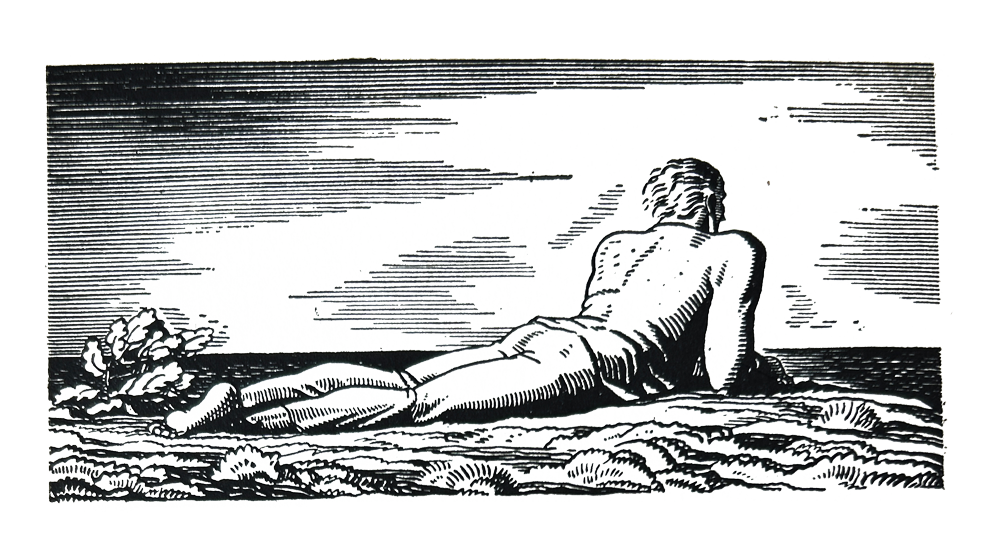
Illustration by Rockwell Kent from Chapter 1